7 Types of Commercial Property Managers & What They Do
Property managers serve as the glue to keep building operations at optimal functionality. When you’re looking to do business with a commercial real estate property, you’ll likely need to connect with and interact with their property managers.
So for this post, we answer some basic questions: What is the role of a property manager? What does a property management company do? What are the different types of property managers?
What Is a Property Manager?
Property management companies oversee and maintain properties on behalf of owners. In addition to managing the day-to-day operations of a commercial building, they are pivotal in improving the property's value, managing risks and fostering tenant relationships. There are roughly nine types of buildings in commercial real estate, and three building classes (A, B and C).
We’ve grouped property management companies into seven categories.
7 Types of Property Management Companies
Here are the seven different property management types:
1. Multifamily housing / residential property managers
Residential property managers oversee apartment complexes, condominiums and other housing units. Their duties include tenant screening, lease negotiations, rent collection and maintenance. For businesses catering to this segment, understanding the needs of residential property managers can promote tailored solutions, such as specialized cleaning services or commercial landscaping geared toward improving curb appeal.
2. Commercial property manager
Commercial property managers handle office buildings, retail spaces and industrial properties. Their responsibilities include attracting and retaining retail tenants, organizing promotional events and maintaining common areas. Service providers targeting commercial property managers may find opportunities to offer solutions related to facility maintenance, security services, energy-efficient technologies and promotional event coordination.
3. Industrial property management
A subset of commercial property management — industrial property management — oversees warehouses, manufacturing facilities and distribution centers. Their responsibilities include managing logistics, coordinating equipment maintenance and assuring compliance with industry regulations as they pertain to the buildings. Businesses targeting industrial property managers might specialize in areas such as industrial equipment maintenance, waste management and logistics solutions.
4. Special-purpose property managers
Special-purpose properties include stadiums, theaters, religious institutions, educational facilities and health care centers. Managers navigate unique operational matters, comply with industry regulations, and prioritize tenant and stakeholder relations. Most special-purpose properties can't be marketed or used for any purpose other than what they were initially intended for. For instance, you're probably not going to turn a church into an apartment complex.
5. Third-party property management firms
Property managers are typically internal (part of the property ownership structure) or external (outsourced to property management companies).
Third-party property managers or management companies are the latter — they’re hired directly by a property owner. A third party property management firm likely has established maintenance vendors, onsite staff, and infrastructure for rent collection for a comprehensive solution to property management. The advantage of outsourcing property management to an external firm is scalability, objectivity and specialized expertise.
An asset owner would pay the third-party management firm a fee for their expertise and services managing the operation of a property. These firms can offer services for residential and commercial properties.
6. Owner-operator property management
An owner-operator can also act as the manager for the property they own. They handle the front-to-back operation of a property, including screening potential tenants, setting rent prices, collecting monthly payments, and scheduling maintenance/upkeep. For larger properties, it’s more efficient to outsource this work, so it’s most commonly seen with small to mid-size properties.
The advantage of an owner-operator style of property management is it offers more control over daily operations, tenant relations and property standards. It also allows property managers to act quickly, offer more personalized services to tenants, and reduce third-party fees.
7. Full-service property management
A full-service property management firm not only offers all of the property management services that you’d expect from a property manager — tenant management, maintenance, etc. — but also can help develop, lease, and market a property. A full-service property manager helps the asset owner maximize the profits of the property, usually in exchange for a portion of the revenue. Since they’re responsible for a broader scope of services, they may take a higher percentage than the above-mentioned third-party property manager.
Still, full-service can be worth it for commercial property owners. A full-service property manager may oversee the conversion of an office to a mixed-use commercial space and manage the new tenants, for example.
How Do Property Management Companies Work?
The simple answer is: A property manager acts as the intermediary between property owners and tenants, handling the building’s operations. Their role is to protect the real estate assets while assuring the well-being and satisfaction of tenants.
Here’s a concise list of what a property management company typically does:
Lease administration: Managing lease agreements, including ensuring compliance
Rent collection: Receiving rent payments from tenants and allocating it to the property owner
Tenant communication and relations: Answering tenant questions and concerns about the property or lease
Property maintenance and repairs: Scheduling on-site maintenance/repairs for tenants
Vendor management: Handling third-party vendors and suppliers related to property updates, maintenance, or repairs
Budgeting and financial reporting: Balancing expenses with rental income
Capital improvement planning: Compiling reports for financing and scheduling property improvements
Compliance with local laws and regulations: Ensuring property compliance with local regulations (such as fire code)
Emergency response coordination: Handling 24/7 response for tenant and property emergencies
Building system monitoring (HVAC, elevators, etc.): Managing and monitoring crucial property infrastructure
CAM (common area maintenance) reconciliation: Determining tenant CAM payments to landlord for shared space usage
Insurance coordination: Evaluating insurance policies and determining the right plan for a property
On-site staff supervision (e.g., janitorial, security): Hiring, training, and managing on-site staff for a property
Tenant improvement oversight: Planning and building improvements to a property or space to make it more attractive to tenants
Occupancy and vacancy tracking: Tracking the percentage of a space that’s occupied and vacant to ensure the property is maintaining profitability
FAQs About Property Managers
Is there another name for a property manager?
Yes, there are several other names, or job titles, for property managers. Some of these titles may have other responsibilities beyond just managing properties. Knowing these alternative titles will help you find property managers in Biscred’s database, which contains contact information for 22,775 property management companies and 316,770 people who work in property management.
Some examples of alternate titles are:
Assistance property manager
Resident manager
Residential property manager
Asset manager
Community manager
Commercial property manager
Site manager
What does a commercial property manager do, versus a residential property manager?
A commercial property manager and a residential property manager have similar overall goals, which is balancing the lease income with property expenses, but have different nuances in how they manage a property. A commercial property manager usually oversees longer-term, large lease contracts and is responsible for building security, maintenance, and management of on-site staff. Residential property managers are concerned with smaller leases of properties. They handle some on-site maintenance like landscaping, maintenance, and repairs.
Who hires property managers? Who do they report to?
Property managers are usually hired by property or asset owners. For residential, this is usually the company or individual that owns the property. The property manager reports to the owner on behalf of the management firm. For a commercial property, it may be an investment firm or a larger corporation that has a board or asset manager responsible for communicating with the property management company.
How to Market to Property Managers
Marketing goods or services to property management firms requires a strategic and targeted approach. Here's a guide on how businesses can effectively market their offerings.
Know your audience: Top challenges of property managers today
Property management can be a thankless job. They're the folks in the middle, caught between budget-conscious owners and demanding tenants. The top challenges facing property managers can include:
Marketing properties to attract quality tenants
Maintaining properties and meeting tenants demands
Dealing with difficult tenants
Regulatory compliance
Managing budgets
Keeping up with technology
Handling emergencies
Attracting, hiring and keeping employees
Develop a targeted marketing strategy
Do your homework (that goes without saying) and get to know the property management firm. Many property management companies in the Biscred database (more than 22,700 in the U.S.) do more than manage properties.
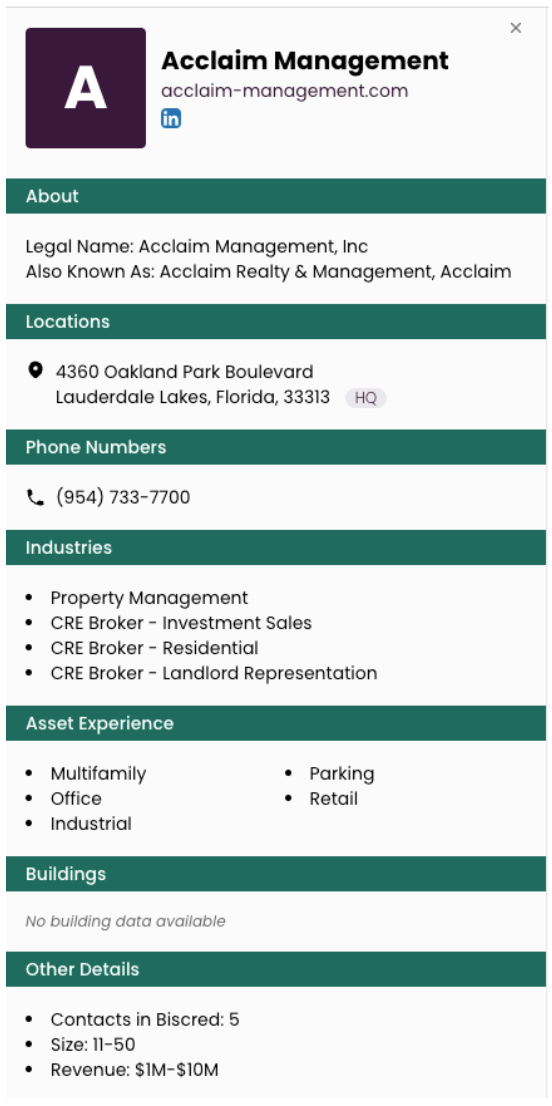
For example, Acclaim Management in Lauderdale, Florida, is a real estate brokerage, investment sales and property management agency.
Identify the specific needs of property management firms by visiting their properties, and determine how your company can address these challenges. Highlight how your goods or services can streamline their operations, reduce costs and improve overall property value.
Hone your relationship-building skills
In a separate post, we offer 23 tips for building B2B relationships, especially for the commercial real estate industries. Sharing industry knowledge and insights can be a powerful way to build trust. It shows that you’re an expert in your field, and you’ve got your pulse on your prospect’s industry, too.
Attend industry events and networking
Participate in industry events, conferences and networking opportunities where property management professionals gather. These events provide a platform to showcase your products or services, network with decision-makers, and stay informed about industry trends.
Implement targeted email campaigns
Provide personalized content that speaks to specific needs and challenges. Highlight promotions, discounts or special offers to incentivize engagement. We have several resources to help companies improve their email marketing campaigns:
Provide cost-effective solutions
Don’t bury the lead (did we just do that by putting this last?): Start your messaging by emphasizing what’s in it for them. Your message should explain how your solutions solve their problems, save them money, and make their customers happy. Highlight the cost-effectiveness of your goods or services. Property management firms often operate within budget constraints, so showcasing the long-term value and potential for cost savings can be a successful approach.
By combining these strategies with Biscred’s robust dataset of CRE contacts, businesses can grow. We invite you to set up a demo of how you can access our database of more than 18,000 property management companies in the United States and find the exact right fit for your product or service.



Comments